

When lines and wrinkles begin to deepen around the forehead, eyes, or mouth, neuromodulators, commonly referred to as wrinkle relaxers, are often the first solution people consider. However, aesthetic medicine has evolved significantly over the past decade. Today, patients no longer have to choose between leaving wrinkles untreated or accepting a rigid, frozen look.
A growing movement toward subtle, preventative aesthetic care has brought micro-dosing (often called “Baby Tox” or “micro-tox”) into the spotlight alongside traditional wrinkle relaxer techniques. Both methods utilize the same underlying aesthetic formulations to relax facial muscles, but they differ fundamentally in dosage, injection depth, and overall philosophy.
Understanding how micro-dosing compares to traditional dosing will help you determine which strategy aligns best with your unique facial anatomy and long-term aesthetic goals.
What Are Traditional Wrinkle Relaxers?
Traditional wrinkle relaxers target the dynamic muscles responsible for expressive facial movements. Every time you smile, squint, or frown, the underlying muscles contract, pulling the skin above them into folds. Over time, these repeated contractions create static lines—wrinkles that remain visible even when your face is completely at rest.
In a standard treatment, targeted doses of a neuromodulator are injected directly into the belly of specific facial muscles. By temporarily interrupting the signals between nerves and these muscles, the treatment relaxes muscle activity, allowing the overlying skin to smooth out.
Key Characteristics of Traditional Dosing:
- Target Area: Deep muscle belly.
- Primary Goal: Substantially soften existing moderate-to-severe lines and prevent strong muscular contraction.
- Typical Duration: 3 to 4 months on average.
- Best Candidates: Individuals with established dynamic or static wrinkles who prefer a noticeably smoother, line-free appearance.
What Is Micro-Dosing in Aesthetic Medicine?
Micro-dosing takes a more delicate, hyper-targeted approach. Rather than delivering full doses directly into the main muscle bodies, a practitioner uses diluted, smaller quantities injected very shallowly into the dermal or sub-dermal layer of the skin.
Because the injections are micro-sized and distributed more evenly across broader zones, the treatment diffuses lightly into the upper muscle fibers without fully immobilizing the muscle itself. This allows you to retain full, natural facial expressions while reducing subtle surface creasing.
Beyond muscle relaxation, micro-dosing delivers secondary skin-quality benefits. When placed intradermally, it can help tighten pores, reduce sebum production, and improve overall skin texture.
Key Characteristics of Micro-Dosing:
- Target Area: Intradermal (shallow skin layer) and superficial muscle fibers.
- Primary Goal: Subtle smoothing of fine lines, pore refinement, and preventative care while maintaining full movement.
- Typical Duration: 2 to 3 months.
- Best Candidates: Younger patients looking for preventative care, or anyone seeking a refreshed, “undone” result.
Side-by-Side Comparison: Micro-Dosing vs. Traditional Relaxers
To help you visualize how these two approaches compare, here is a breakdown of their primary differences:
| Feature | Micro-Dosing (“Baby Tox”) | Traditional Wrinkle Relaxers |
| Injection Depth | Superficial / Intradermal | Deep Intra-muscular |
| Dosage Unit | Low, micro-quantities per point | Standard medical units per zone |
| Facial Mobility | 100% natural movement preserved | Controlled, softened muscle movement |
| Primary Indication | Early fine lines, texture, preventative care | Moderate to deep dynamic wrinkles |
| Secondary Benefits | Pore tightening, oil control, surface smoothness | Long-lasting muscle relaxation |
| Longevity | ~2 to 3 months | ~3 to 4 months |
How to Choose the Right Strategy for Your Skin
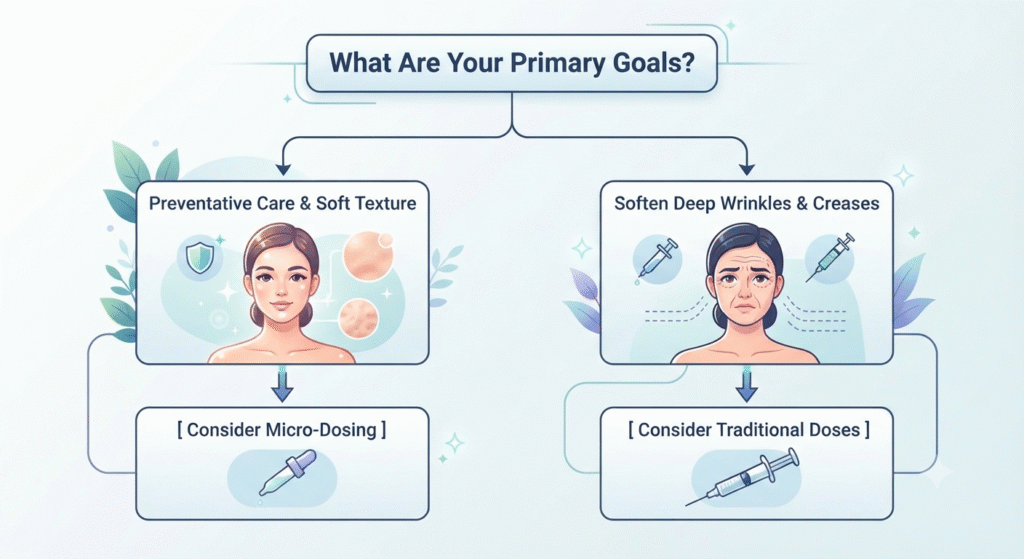
Deciding between micro-dosing and traditional treatments comes down to your age, skin elasticity, and personal preference.
Choose Micro-Dosing If:
- You want to start preventative care: If you notice fine lines starting to form when you express yourself, but they disappear when your face rests, micro-dosing keeps them from deepening.
- You value maximum expression: If your career or personal preference requires complete expressive movement, micro-dosing avoids any feeling of stiffness.
- You want comprehensive skin refreshment: Combining low-dose relaxers with a tailored skin booster treatment can drastically improve skin hydration, elasticity, and subtle surface lines simultaneously.
Choose Traditional Relaxers If:
- You prefer longer intervals between appointments: Standard dosing typically holds its results longer than micro-dosed treatments.
- Lines are visible at rest: If frown lines or crow’s feet remain visible when your face is completely relaxed, full-strength intramuscular injections provide the structural relaxation needed to smooth them out.
- You have stronger facial muscles: Certain areas, like the glabella (between the eyebrows), often require standard dosing to prevent strong squinting or furrowing.
Combining Treatments for Holistic Skin Health
Aesthetic practitioners increasingly view wrinkle relaxers as just one part of a multi-layered skin care regimen. While neuromodulators address muscle movement, they do not repair structural collagen loss, sun damage, or deep skin dehydration.
To achieve truly glowing, youthful skin, combining relaxation treatments with structural skin therapies yields superior results:
- For Cellular Repair & Regeneration: Pairing light relaxer treatments with a targeted rejuran treatment helps repair damaged dermal structure, boosting collagen production and skin resilience from within.
- For Surface Tone & Clarity: Addressing dead skin buildup through a periodic peeling treatment ensures that your skin reflects light evenly, enhancing the smooth effect achieved by your injectable treatments.
FAQ
Yes. Many patients start with traditional dosing to smooth out deeper lines, then transition to micro-dosing for maintenance once those lines have softened. Your practitioner can adjust your plan based on how your skin responds over time.
While micro-dosing uses fewer units per session, it requires precise injection placement across more points on the face. Additionally, because micro-doses break down slightly faster, sessions may be required more frequently. Overall investment is often comparable over the course of a year.
Results from micro-dosing typically become visible within 3 to 7 days, with full skin-smoothing and pore-refining effects establishing by day 14.
No. Because micro-dosing acts superficially on small muscle fibers and dermal receptors, it creates a subtle, radiant glow and smoother skin texture without immobilizing your expressions.