


When you first start noticing lines, shadows, or volume changes on your face, navigating the world of non-surgical aesthetics can feel overwhelming. Two names dominate almost every discussion about anti-aging treatments: dermal fillers and muscle relaxers.
While both are administered via precision injections and yield impressive facial rejuvenation results, they work in completely different ways, target different types of wrinkles, and serve distinct aesthetic goals. Choosing the right one, or knowing when to combine them, is the key to achieving natural, refreshed results.
Here is a clear, medical-perspective breakdown to help you understand which treatment aligns best with your cosmetic goals.
Understanding the Basics: How They Work
To choose between fillers and muscle relaxers, you first need to understand the fundamental difference in how they interact with your facial anatomy.
What Are Muscle Relaxers?
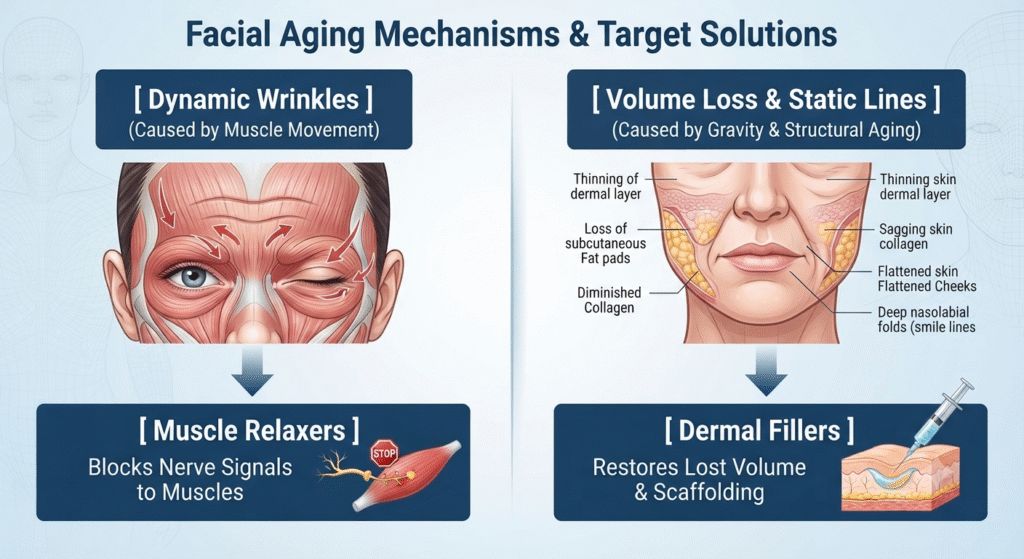
Muscle relaxers (neuromodulators) temporarily relax specific facial muscles. Every time you smile, squint, or frown, the underlying muscles contract, pulling the skin and creating creases. Over time, these repeated movements form visible lines.
By blocking the nerve signals that tell those specific muscles to contract, neuromodulators allow the skin above to smooth out. They do not add volume; rather, they prevent the active muscle tugging that deepens dynamic lines.
What Are Dermal Fillers?
Fillers, as the name implies, physically restore lost volume and structural support. As we age, our faces naturally lose subcutaneous fat, collagen, and bone density. This causes skin to sag, deep folds to form, and areas like the cheeks or under-eyes to appear hollow.
Most modern dermal filler treatments use Hyaluronic Acid (HA), a naturally occurring sugar molecule in the skin that binds to water molecules. When injected, fillers act like a cushion to lift sagging tissues, plump thin lips, smooth out deep static creases, and reshape facial contours.
Dynamic vs. Static Wrinkles: The Key Decision Factor
The fastest way to determine whether you need a relaxer or a filler is to assess when your wrinkles appear.
- Dynamic Wrinkles: These appear only when your face is in motion (e.g., lines around your eyes when smiling or forehead creases when raising your eyebrows).
- Best Solution: Muscle Relaxers
- Static Wrinkles: These are visible even when your face is completely relaxed and still (e.g., deep smile lines from the nose to the mouth, or hollow cheeks).
- Best Solution: Dermal Fillers
Direct Comparison: Fillers vs. Muscle Relaxers
To help you visualize how these two aesthetic options stack up, here is a quick reference guide:
| Feature | Muscle Relaxers | Dermal Fillers |
| Primary Mechanism | Relaxes underlying target muscles | Plumps tissue & restores volume loss |
| Ideal Treatment Areas | Forehead lines, crow’s feet, frown lines (glabella) | Cheeks, lips, nasolabial folds, jawline, chin |
| Wrinkle Type Targeted | Dynamic wrinkles (movement-based) | Static wrinkles & structural hollows |
| Onset of Results | 3 to 14 days post-treatment | Immediate visual correction |
| Typical Longevity | 3 to 4 months | 6 to 18 months (varies by formulation) |
| Feel / Texture | Unnoticeable (acts on nerve pathways) | Subtle gel cushion beneath the skin |
Can You Combine Both Treatments?
Absolutely. In fact, full-face rejuvenation often yields the most natural outcomes when both modalities work together. For instance, treating severe forehead creases might require a muscle relaxer to stop active creasing, paired with a soft filler layer to plump up deep set-in lines.
Additionally, modern aesthetic medicine frequently integrates holistic skin quality treatments alongside structural injectables. If fine surface texture or mild crepiness remains an issue across larger areas, clinicians often recommend incorporating injectable skin boosters to deeply hydrate the dermis, or utilizing meso botox techniques to tighten micro-muscles and refine pore size without restricting expression.
Which One Is Right for You?
Your final decision should rest on your specific aesthetic concerns during a face-to-face clinical evaluation. However, as a general rule of thumb:
- Choose Muscle Relaxers if: You want to soften expressive forehead furrows, smooth out crow’s feet around the eyes, or prevent fine expression lines from becoming permanent static creases.
- Choose Dermal Fillers if: You notice sunken cheeks, thinning lips, deepening folds around your mouth, or sagging along your jawline that requires volume restoration.
Consulting an experienced aesthetic practitioner ensures your facial structure is properly analyzed, leading to a customized treatment plan tailored to your natural expressions.
FAQ
Discomfort is minimal. Muscle relaxer injections use extremely fine needles and take only a few minutes. Dermal filler procedures often involve topically applied numbing cream and contain local anesthetics mixed directly into the gel to ensure a comfortable experience.
Not when administered correctly. A subtle, natural look comes down to precise dosage and placement. Skilled practitioners target only the hyperactive muscles responsible for unwanted lines while preserving your natural facial expressions.
Muscle relaxers typically wear off gradually over 3 to 4 months as nerve signaling recovers. Dermal fillers last longer, usually anywhere from 6 to 18 months, depending on the product density and how quickly your body metabolizes the material.
Hyaluronic acid-based fillers can be safely dissolved using an enzyme called hyaluronidase if adjustment is needed. Muscle relaxers cannot be dissolved immediately, but their effects are temporary and will fade naturally over a few months.